

The Four Angles
What do the 1st, 4th, 7th and 10th house mean?

The four angular houses, the 1st, 4th, 7th, and 10th, do not directly correspond to the cardinal signs Aries, Cancer, Libra, and Capricorn, although these are respectively the 1st, 4th, 7th and 10th signs of the zodiac. Pop astrologers often use the “natural house” system, linking Aries to the 1st house, Taurus to the 2nd, and so on. But ancient Greek (Hellenistic) and Vedic astrologers did not align zodiac signs with houses. Instead, Hellenistic astrologers assigned “planetary joys,” or affinities between planets and houses. Not every house has a planetary joy, as there are twelve houses and only seven traditional planets: Moon, Sun, Mercury, Venus, Mars, Jupiter and Saturn. For example, rather than the 1st house being like Aries, it is considered the joy of Mercury. Out of the four angular houses, the 1st is the only house with a planetary joy. But each angular house (1, 7, 10, 4) respectively corresponds with the four angles: Ascendant, Descendant, Midheaven and Imum-coeli.
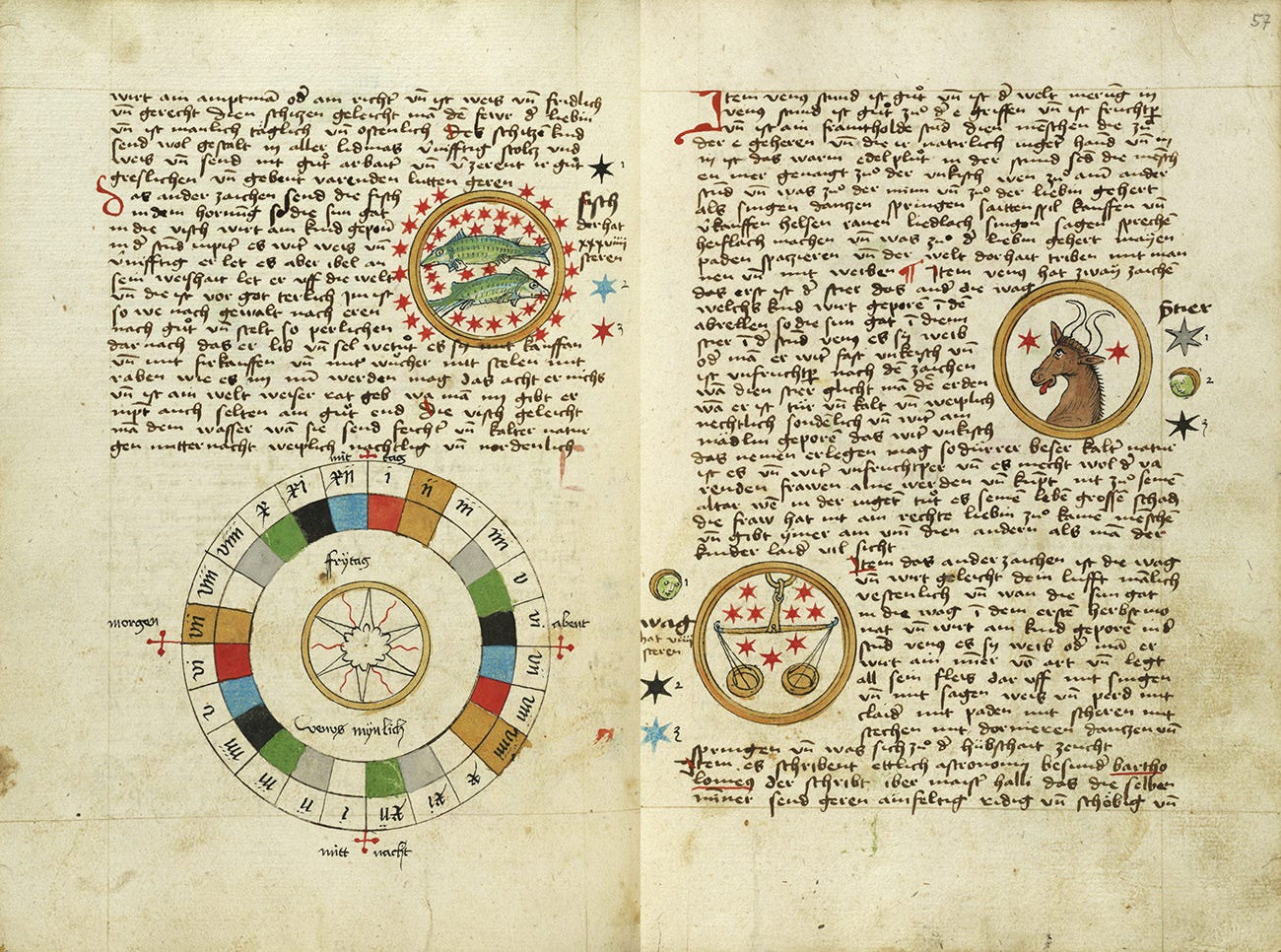
The first house is referred to as Horoskopos (ὡρόσκοπος) or “hour-watcher.” It contains the sign rising over the eastern horizon at the moment of your birth. It also metaphorically represents the sunrise, lifting forms out of nocturnal obscurity. The rising sign is the most responsive, dynamic and unique part of the chart because it changes every two and a half hours. The first house and rising sign govern the visible parts of self like our physical appearance, body and identity. Despite their importance, these parts are changeable—we grow and age and change is a key theme of Mercury.
Mercury completes roughly four revolutions around the sun in the time that it takes Earth to make one. So it moves fast much like the rising sign. Mercury is a relational and cerebral planet. It represents the aspects of society that depend on exchange like trade and communication. As the only planet without gender, it occupies a unique refuge, free from the extremes and overt qualities that gender imparts. This mildness is advantageous in commerce, analysis and delivering news. However, Mercury’s inherent queerness was viewed with suspicion in ancient times, and seen as deceptive or ambiguous. The origin of its enduring reputation as the trickster…
Mercury does not confront, it negotiates. It attains not by force or sex appeal, but through cleverness. The first house signifies our emergence into the social world, while Mercury represents interaction, exchange, and participation within society in an active yet featherweight way. In traditional astrology, success is measured by conformity to the prevailing status quo and Mercury embodies a subtle yet potent form of influence that transmutes as much as it attracts. It can “break the rules” without getting caught. There’s something present yet imperceptible about it, much like the sun moving shadows through the day.
While this correspondence between Mercury and the 1st house makes sense and tickles me, pop astrologers moved away from ancient orthodoxy and popularized a simplified blending of signs and houses. I think this simplification, made in good faith, intends to make astrology less deterministic and more symbolic. But catch-alls are easy to sell, so the distortions we see aren’t entirely innocent. They are part of what make astrology profitable.
What was once a precise language is now the stuff of digital litter. Vastness tends to draw in waste and while the internet’s clutter is invisible, it is closer than we think. As we increasingly merge with technology we become what Donna Haraway calls “chimeras, theorized and fabricated hybrids of machine and organism; in short, we are cyborgs.”
The rise of waste and consumptive excess alongside minimalism and modulation defines our times. And this ethos reshapes how we understand symbols and language, therein affecting the language of astrology. When there is little specificity, there is no clarity. And confusion is the currency of domination. Mark Fischer says, “Capitalism is what is left when beliefs have collapsed at the level of ritual or symbolic elaboration, and all that is left is the consumer‑spectator, trudging through the ruins and the relics.”

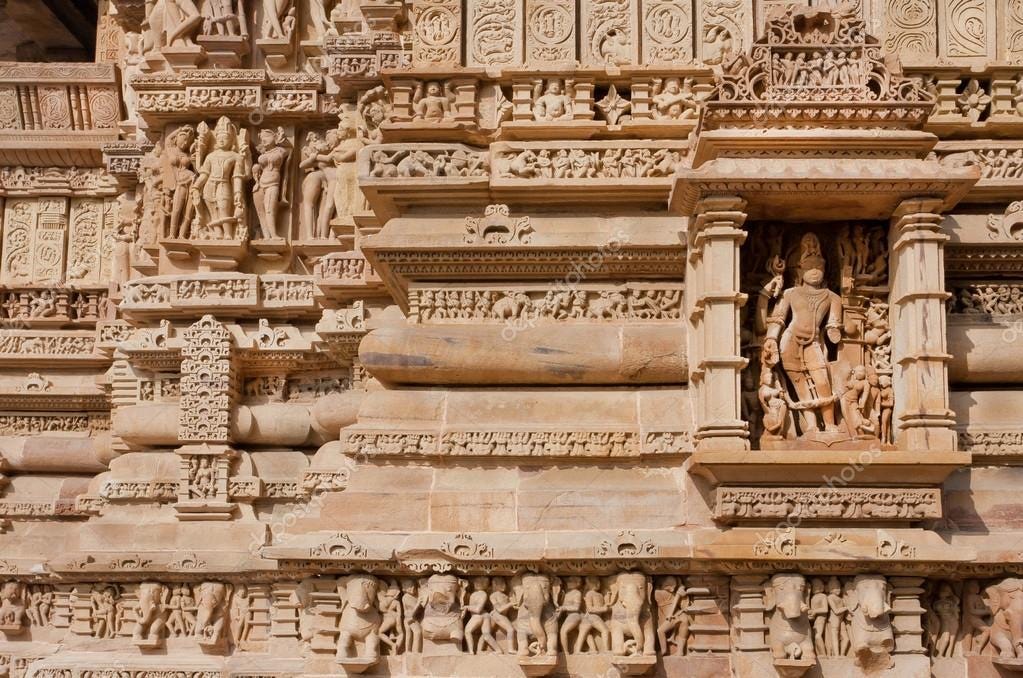
I understand and share the instinct to move away from rigid traditions. When I open the Phaladeepika, a Hindu text written likely 800 years ago, and read, “When the Sun is in the 7th [house] at birth, the person concerned will suffer from the wrath of the king,” I’m like, k…Astrology should change because people do and thanks to global cultural exchange we can now explore those evolutions.
So why is the Sun said to suffer “the wrath of the king” in the 7th house? The 7th is Dusis (Δύσις) or “descendant.” It opposes the 1st house of self, and can therefore represent the individual’s open enemies. It’s widely known as the house of marriage and relationships, so relational planets like Mercury and Venus may fare well here, provided they’re in good condition. But the Sun can struggle, because it is inherently dominating, while the 7th house asks for cooperation. Metaphorically, if the Sun rises in the 1st house, it must set in the 7th. That sunset symbolizes the Sun falling from its peak, lowering itself to the ground of what is shared, negotiated, and common. It’s also the end of the day, and the beginning of the Moon’s dominion over the sky. Night, after all, can be likened to death.
Some reject traditional astrology, but dismissing it entirely overlooks the opportunity to consider diverse perspectives. We now have the luxury to synthesize different, intersecting insights, and this blend makes astrology vital and relevant today. Although the wrath of kings is a scary vibe, it’s a threshold that helps us understand the sun in the 7th house outside of pop culture calling it “relationship oriented,” which is a half-truth anyway. There are effective ways to radicalize astrology without eroding its complexity…and honestly, its beauty and perhaps this approach can cut through the symptomatic nihilism of our times.
I’d like to offer this model instead of the popular shorthand. A cross, orienting us in Chōros (space) and Chronos (time), the dual structure of material reality. I see the angular houses as two overlapping coordinate systems:
1 ☍ 7 & 10 ☍ 4 — The Angular Houses, The Four Directions
1st and 7th houses: time — birth and death
4th and 10th houses: space — ground and sky
And rotated again:
1st and 7th houses: space — self (here I am) and other (there you are)
4th and 10th houses: time — origin (our roots & memories) and legacy (our actions & how we are remembered)
When I began my studies, most of my exposure came from the internet. I would encounter ideas like “the 10th house=career” but the resources I found rarely explained why. Thoughtful insights exist but, again, are often obscured by an excess of uninspired, consumptive fodder. And a consumptive consciousness does not introspect upon itself, so many, even advanced texts, rarely remark on how capitalism has shifted the meaning of say, the 10th house, which is explicitly predicated on economy and class.
As I got deeper in my studies, I began to see the chart as a clock. The houses representing different stages of the sun in the sky:
1st House — sunrise: bright, rising
7th House — sunset: dim, declining
10th House — noon: bright, blinding
4th House — midnight: dim, invisible
The 10th house, at the top, represents the blinding sun at it’s highest, most exposing point. It’s the worst time to take a photo because the harsh light overexposes and bleaches everything. This overexposure is like fame and reputation, conditions that erode and make headlines out of private affairs. Vedic astrologers call the 10th house the Karma Bhava, or house of actions, while Hellenistic astrologers refer to it as the summit, mesēmbriā (μεσημβρία), or “mid-day.” In short, it is the house of career, action, reputation, legacy, honor and upward mobility. Like a tower being built into the sky.
Aspects tell us how houses relate to one another geometrically. The 10th house forms a trine (a 120° angle) with the 6th house, the domain of labor and obligations. It can be confusing for one house to represent career, and the other to represent work. If we have jobs we don’t like, the 10th house can feel like this ambiguous thing we have to solve in order to get out of our shitty 6th house jobs.
In astrology, trines are harmonious aspects. They represent flow between parts of the chart. In Platonism, mathematical proportion is the basis of beauty. Hellenistic astrology was a kind of “beauty-as-math” project for ancient thinkers. Trining houses always contain signs of the same element. For example, if your 6th house is in Capricorn, your 10th will be in Taurus—both earth signs which click together.
Studying the dynamic between the 6th and 10th houses can reveal how ideas of purpose shift in relation to the economy. Today, these houses describe the relationship between productivity and achievement. The 10th house, associated with public status and authority, relies on the labor of the 6th, which traditionally governs hard work, domestic animals, servitude, and enslaved classes. This trine, then, also speaks to the relationship between power and exploitation.
In Vedic astrology, the 6th house is considered an upachaya house—a place that improves with sustained effort. The exertions of the 6th can lead to the fulfillment of the 10th.
Ancient texts did recognize careers as a theme of the 10th house. But only to the extent that they were accessible and permissible with the sociopolitical structures of the time. Besides, who were natal charts being cast for? Who was time kept and recorded for? Certainly not for ancient working classes.
Alice Sparkly Kat sheds light on the hyper-militarization of the ancient ruling classes, “There is an aspect of the tenth house that is about the state. I know that, when we think about the modern career, we are often thinking about a bloated private sector. However, careers weren’t always about the corporation. They used to be about maintaining the state.” In today’s imagination, there is a divide between education and the military, but they were in fact much more intertwined, forming the intersecting ways by which men attained and held status. The ideal citizen was both a thinker and warrior, defender and lover of the homeland. I was talking to someone recently who said the American Dream is only attainable for the military class, who get free healthcare and education if they serve. I suppose things are not so different today.
Status is vertical and measured by institutions. It is not inherently self-determined, yet contemporary culture often conflates status with purpose, though purpose, by contrast, arises from a self-determined place. I don’t mean to be all V for Vendetta, but we have been sold the illusion that purpose as defined by and achieved within capitalism will fulfill us. But this is a hedonistic myth. Buddhist scriptures teach that craving and desire lead to dukkha (suffering), and true fulfillment arises from letting go and cultivating contentment or humility. This is entirely different from what modern life demands and what the 10th house has come to represent.
The 10th house is indeed about praxis, action in the public world, but that action may or may not be connected to anything fundamentally personal. It could reflect purpose shaped by the state, as in ancient times, or by capitalism, as in modern times (not that these are mutually exclusive). How we define purpose reveals our worldview, our values, and the degree of our self-authorship. Where do our aspirations come from? Who models them for us? The 10th house can represent any authority, encompassing the celebrity to military pipeline.
When viewed as a tool for self-actualization, astrology invites us to approach the 10th house introspectively rather than prescriptively. A useful question to ask is: if you were a character in a movie, what role would you want to play? It’s not that you must play that role, but it offers insight into what you perceive as powerful, whether a supervillain, an ethereal girl, an animated cat, or perhaps whether you even think much about power at all. How much of your fantasy of action is determined by you holding power?
To radicalize our conception of the 10th house, then, is not to reduce it to purpose, a vague and often ambiguous term, but to understand it as a reflection of our relationship with institutions and ideologies of power. The pervasive expectation that everyone must find purpose through a career is a distorted promise that limits the scope of what the 10th house has to offer. Now that knowledge is more democratized, we can define astrology outside of and in response to the status quo, rather than from within it.
The other day, a woman on TikTok, who’s video I didn’t save so I can’t properly credit her, said true icons have an intimacy with boredom. They embody the existential, which gives them a unique signature. Something real to be famous for. She contrasted the mainstream vibes of Addison Rae with the elusive aura of 2hollis. Despite her contrast, I think they have similar nostalgic signatures. Addison channels Britney while 2hollis riffs on Crystal Castles.
Nostalgia has become a smokescreen for late capitalism. The past is recast as fiction, from which an arbitrary and endlessly renewable crown of authenticity is mined. I feel like I’m putting myself in a bit of hot water by bringing up two people I have one degree of separation from, but I am developing adult-onset allergies to celebrity culture, so fuck it. I will say that both of their music slaps.
Her idea strongly evokes the relationship between the 4th and 10th houses: the place of mystery and the place of exposure. Though the 10th house is bright and sovereign, it can feel uncomfortable because it’s karmic, as in, it is about results, good or bad. The unsteadiness and actions of the 10th oppose the steadiness and privacy of the 4th, creating a vital axis in astrology.
The imum-coeli, or nadir of the chart, can fall anywhere between the 3rd, 4th and 5th houses, which gives us insight into what our foundation might be. The 3rd house represents spiritual rituals, interests and the courage to express one’s skills. The 4th house represents ancestors, property and respite. The 5th house represents creativity and children.
The 4th house is the Hypogeion (Ὑπόγειον) or “under-earth.” It is a cave of invisible things and the osmotic thickness of endings. It is your brief and unexpected affair with an old postcard at a flea market. Your affair with a man’s unintelligible handwriting and the image of the sky he picked out for his wife, long before you came to notice, long before his privacy became your epiphany of absence.
The 4th house cannot be invaded. Desecration only hurts humans, not souls or ancestors. Ancestors are the eternal glass of our humanity, reflecting back with the same force with which we have acted. Nothing gets lost or slips away here. Even if you do not see it, it is there. It is the house of history yet is it not the house of proof. It is the house of feelings and feeling as proof enough.

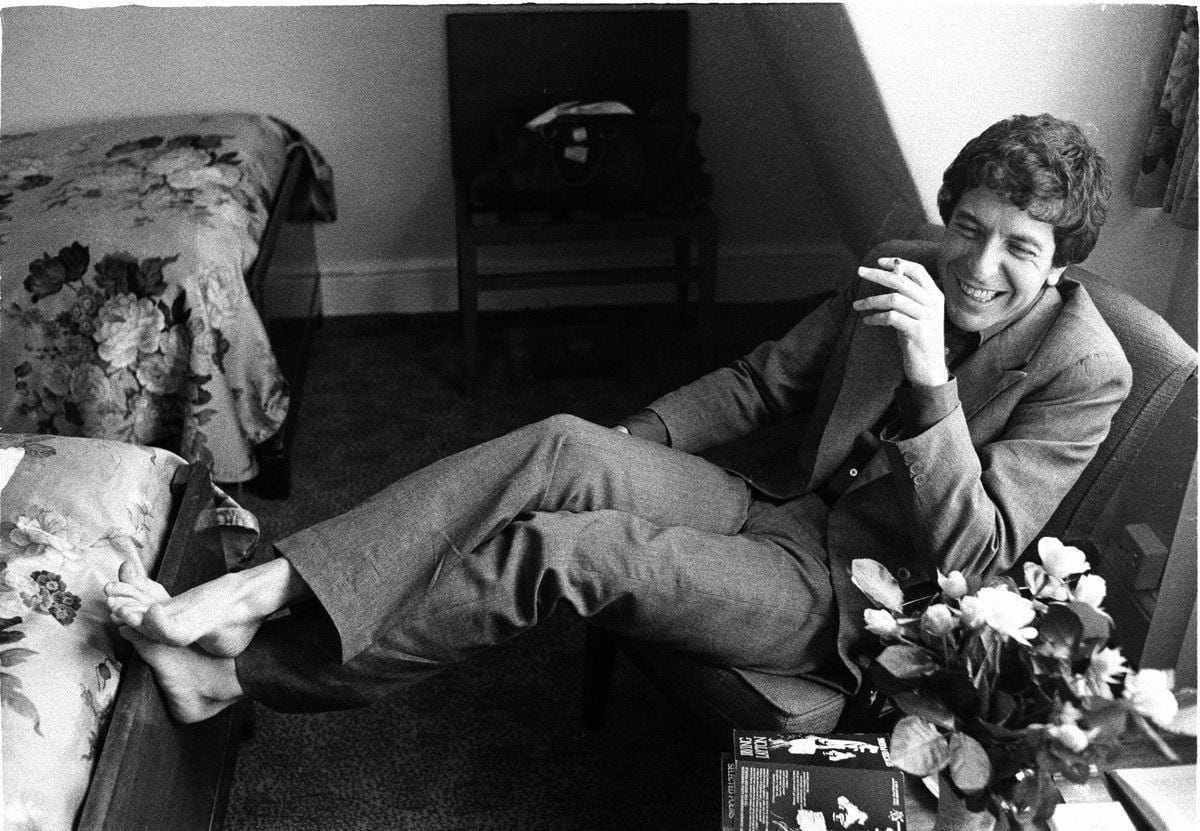
This mystery is the currency of art. Mystery comes from myein, "to close the eyes or lips." It implies secrecy. In astrology, the Sun and Moon are called luminaries because they illuminate. Art offers a little confession, without completely undoing the mystery from which it came. Leonard Cohen, who is a quintessential man of mystery said something like, “If your life is burning well, poetry is just the ash.” The 4th house can be thought of in this way.
Okay, that was a long one, but many blessings, hope you guys enjoyed it!
Thank you so much for this Ilana, there's great information and insights in here! And it's definitely a double-read for me! :))
incredible, wow, thank you so much 💐🥰